


Kids' Routine Device vs. Alarm Clock: What's the Difference
- by Cozyla Team
- by Cozyla Team
 United States
An alarm clock does exactly one thing well: it tells a child the day has started.
What happens next — the getting dressed, the breakfast, the teeth brushing, the backpack packing — is entirely up to the child. And for most young children, that's precisely where the morning falls apart. Not at the wake-up. At everything after.
So the question isn't really "does my child need an alarm clock?" It's "does my child need help waking up — or help with what comes next?"
An alarm clock is a simple, reliable tool — and for the right child, it's enough.
Traditional alarm clocks, sunrise alarm clocks, and ok-to-wake clocks all do their job well within a defined scope. A sunrise alarm clock gradually fills the room with light to wake children more gently than a buzzer — a genuine improvement for light-sensitive kids or early risers. An ok-to-wake clock uses a color signal to let young children know when it's actually morning — useful for toddlers who wake at 5 AM and need a visual boundary before getting out of bed.
For older, self-directed children who simply need a reliable wake-up signal and can take it from there — a good alarm clock is all they need. But for younger children? Waking up is rarely the hard part.
Here's what a sunrise alarm clock, an OK-to-wake clock, or any alarm clock cannot do: tell a child what to do after it goes off.
The alarm sounds. The light turns green. The child is awake. And then — nothing. Because knowing the day has started is very different from knowing how to navigate it.
Without a visible structure to follow, most young children default to the path of least resistance: staying in bed a little longer, drifting toward a toy, or simply waiting until a parent appears to tell them what comes next. The alarm clock hands the morning back to the parent the moment it goes off.
For families with young children, the wake-up was never the problem. The next forty-five minutes were.
A kids' routine machine like Cozyla Routie doesn't just signal the start of the day.
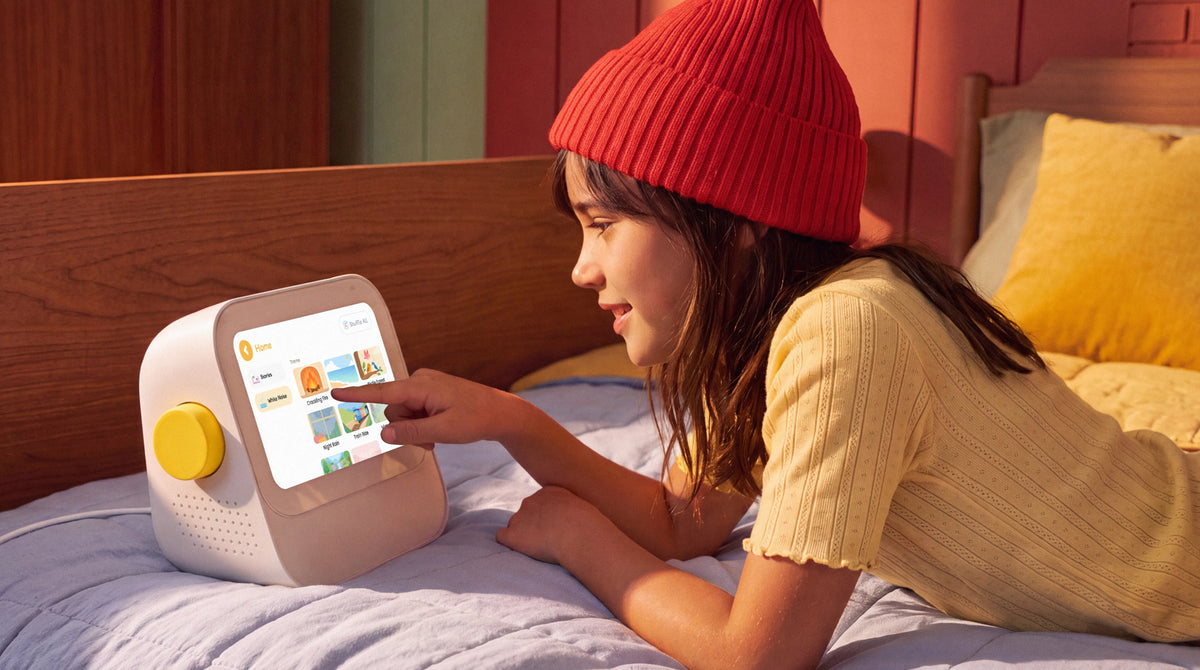
Cozyla Routie is an AI-powered bedside companion designed specifically for children aged 4–12. Unlike an alarm clock that stops at the wake-up, Routie guides children through the entire day — from the first light of morning to the last step before bed. Its full-spectrum LED array wakes children gently with a sunrise simulation instead of a buzzer, while an OK-to-wake light signals younger children when it's actually time to get up. From there, AI-guided routines use adaptive light, sound, and voice prompts to walk children through each step of their morning independently — making Routie a genuine routine reminder for kids that replaces the parent's voice in the routine without replacing the parent.
At bedtime, Routie becomes something even more personal. A one-tap button on the front of the device triggers a calming, breath-paced light and a pre-recorded parent voice — giving children a self-directed way to settle at night. And with parent voice cloning, Routie can read bedtime stories in a parent's own voice, even when they're away from home. As a kids' routine tracker that lives in a child's bedroom, it's also built with privacy at its core — no camera, a physical microphone switch, and a visible red privacy indicator. It syncs seamlessly with the broader Cozyla family system, connecting routines, tasks, and rewards across the whole household. And like everything Cozyla makes — it's always completely ad-free.

Here's an honest way to think about it:
An alarm clock — including a sunrise alarm clock or ok-to-wake clock — is the right tool for an older, self-directed child who needs a reliable wake-up signal and can manage the rest of the morning on their own.
A kids' routine device is the right tool for a young child who needs guidance not just to wake up, but to move through the morning independently — step by step, without a parent directing every move.
If the alarm goes off and the morning still requires you to be the schedule, the reminder, and the motivator — the alarm clock isn't solving the right problem. A kid's routine coaching machine is.
Any clock can start the morning. What happens next is where most families need the most help — and where Cozyla Routie makes the biggest difference.
More than an alarm clock, more than an OK-to-wake light — Routie is a dedicated routine helper for kids that guides children from the first light of morning to the last step before bed, building the kind of independence that makes every day a little easier for the whole family. Discover Cozyla Routie now and find out what happens when the routine belongs to your child.
More ways to simplify family life.
A Smarter Way to Plan Homeschool Days with Cozyla AI Voice Agent
Read moreabout A Smarter Way to Plan Homeschool Days with Cozyla AI Voice Agent
Kids' Routine Device vs. Alarm Clock: What's the Difference
Read moreabout Kids' Routine Device vs. Alarm Clock: What's the Difference
How to Build a Reward System That Keeps Kids Engaged at Home — with a Digital Calendar